What is Graphic Medicine? And Why Health Writers Should Use It
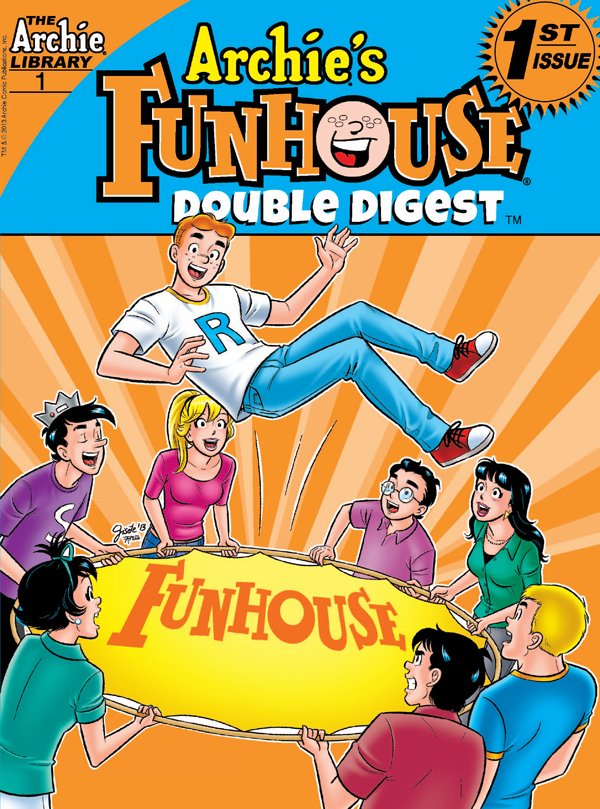
When I was 11, I fell in love for the first time. His name was Archie. Archie Andrews. His hair was the colour of farm-fresh carrots. His freckles were the colour of tar. He was allergic to homework. Sadly, he didn’t feel about me the way I felt about him. But he was gracious enough—in an oblivious way—to let me witness him volley his affection between Betty and Veronica.
*
Reading comics about Archie and his gang burrowed a hole deep into my memory. With 24/7 access to expanding seas of information, can health writers use comics to capture their readers’ attention like Archie caught mine? Absolutely.
Graphic Medicine Grabs and Keeps Your Attention
Comics are a powerful medium that has captured and entertained us for decades. The film, Avengers: Endgame, has grossed almost close to 3 billion US dollars worldwide!
While popular thanks to Hollywood, comics are used in healthcare too, where they’re called graphic medicine. Ian Williams, known as the pioneer of the term, defined graphic medicine as:
A primer video about what graphic medicine is by the Association of American Medical Colleges (AAMC).
“the intersection of the medium of comics and the discourse of healthcare”.
This subgenre of comics combines images and text to communicate about health care. In this context, the word “medicine” means to restore or preserve health—medicine in a bottle so to speak—rather than to convey that it’s exclusive to the medical profession.
The traditional western approach to learning focuses on text. But,
“visual understanding is intuitive in ways that verbal understanding may not be” (Green & Myers, 2010).
Two people, from two different countries, who speak two different languages can gaze at the same painting of a dairy cow, and understand what they’re looking at. This understanding isn’t the same with text. Une vache laitière dans un champ to a Japanese grandmother means, Hata no nyūgyū to a French baker. Not much. Unless they take out their iPhones and Google translate it.
Graphic Medicine Celebrates Storytelling
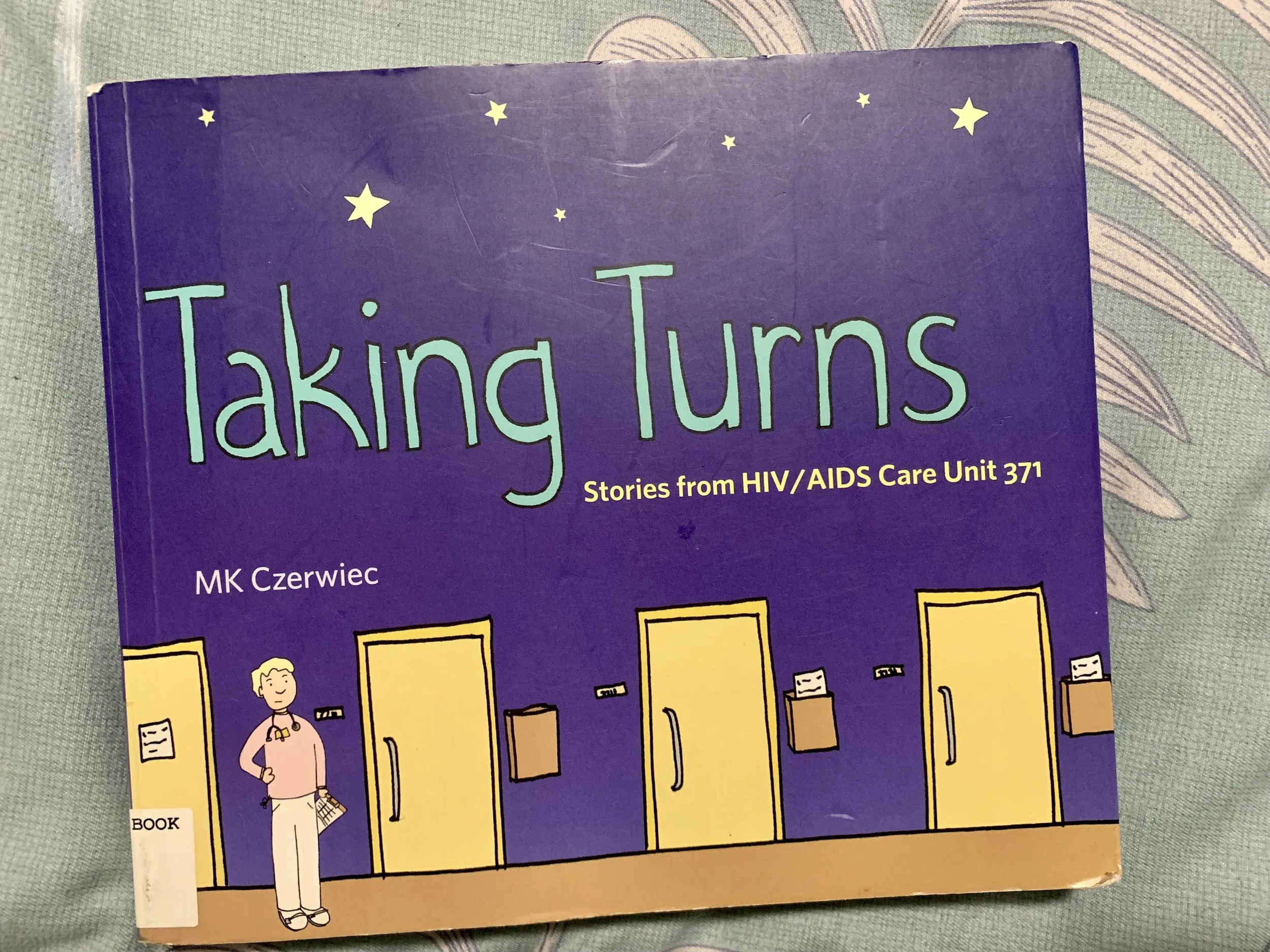
The graphic medicine book, Taking Turns, by MK Czerwiec.
Graphic medicine recognizes storytelling as a central part of understanding health and illness that facts alone may not. Stories are what colours the human experience. They bind us together and teach us about life’s nuances. My mom told me stories about her uncle—who was a soldier in the second world war—going “berserk” every month. Her stories taught me more about the cloak of horrors that soldiers wear post-war than the definition of PTSD ever could.
Graphic medicine acknowledges that every person has a unique experience of health and illness. By recognizing that a person's experience shouldn’t always be separated from the science, the reader can understand, viscerally, what an illness is, what to expect, and what different treatments feel like.
An example of graphic medicine is the book, Taking Turns, by nurse and cartoonist MK Czerwiec. She tells her story about working on an HIV/AIDS unit in a Chicago hospital during the height of the epidemic. Her narrative takes place in and outside of the hospital, in and outside of her head, and through conversations with patients and colleagues. You’re pulled into MK’s professional and personal journey caring for stigmatized patients, some of whom became her friends. Many of her patients, many of her friends, died on the unit. MK explores how this affected her.
But What If You Can’t Draw?
As a health or medical writer, you don’t need to be the next Stan Lee. You just need to write well. Sure, I can draw. My 3-year old can’t get enough of my stick figures doing the typical stick figure things—standing, running, holding a lollipop. My 6-year-old, on the other hand, is catching on to the truth that my talent peaked around the time I lost my first baby tooth.
Instead of agonizing over getting your drawing skills where you want them to be, you can partner with talented artists who are interested in health science. That’s what I did. I created a graphic medicine about the minimally-invasive cosmetic treatment, Platelet-Rich-Plasma (PRP). Instead of publishing my interview with aesthetic nurse, Jessica Varga, in text-only form, I teamed up with an illustrator to bring my storyboard to life.
To Sum Up
Graphic medicine is powerful medium that health and medical writers can use to grab and keep their readers’ attention. Visuals and text together can communicate complex health information through storytelling, acknowledging the human experience of health and illness.
Graphic medicine also allows you, as the writer, to instil your artistic side that appeals to your reader’s sentient side. There’s no one universal experience. And graphic medicine honours that.
Resources
Czerwiec, M. K, Williams, I., Squier, S. M., Green, M. J., Myers, K. R., & Smith, S. T. (2015). Graphic medicine manifesto. Penn State University Press.
Green, M. J., & Myers, K. R. (2010). Graphic medicine: Use of comics in medical education and patient care. BMJ Clinical Research, 340(c863). https://doi.org/10.1136/bmj.c863
National Library of Medicine. (29 December, 2020). Graphic medicine: Ill-conceived & well-drawn! https://www.nlm.nih.gov/exhibition/graphicmedicine/index.html
Williams, I. (2021). What is graphic medicine? https://www.graphicmedicine.org/why-graphic-medicine/