

5 Things You Can Expect During An MRI Scan to Screen for Breast Cancer
Courtesy of my family history, I’ve had three MRIs in the past two years to screen for breast cancer. I go back and forth between MRIs and mammograms, with a breast ultrasound thrown in for good measure.
You’ve probably seen an MRI on TV—that monstrous machine that seems to have swallowed a person whole.
But what’s it like to have an MRI scan? First, let’s go over the basics.
What’s an MRI?
MRI stands for magnetic resonance imaging. It’s a machine with a large magnet that makes images of a certain part of your body like your soft tissue, organs, ligaments, spinal cord, or blood vessels. The pictures help doctors diagnose all sorts of medical conditions like strokes, heart disease, multiple sclerosis, brain aneurysms, tumours, and cancer. The images also show how you’re responding to treatment.
An MRI scan can last anywhere from 15 to 90 minutes, depending on which body part is being scanned.
How Does An MRI Work?
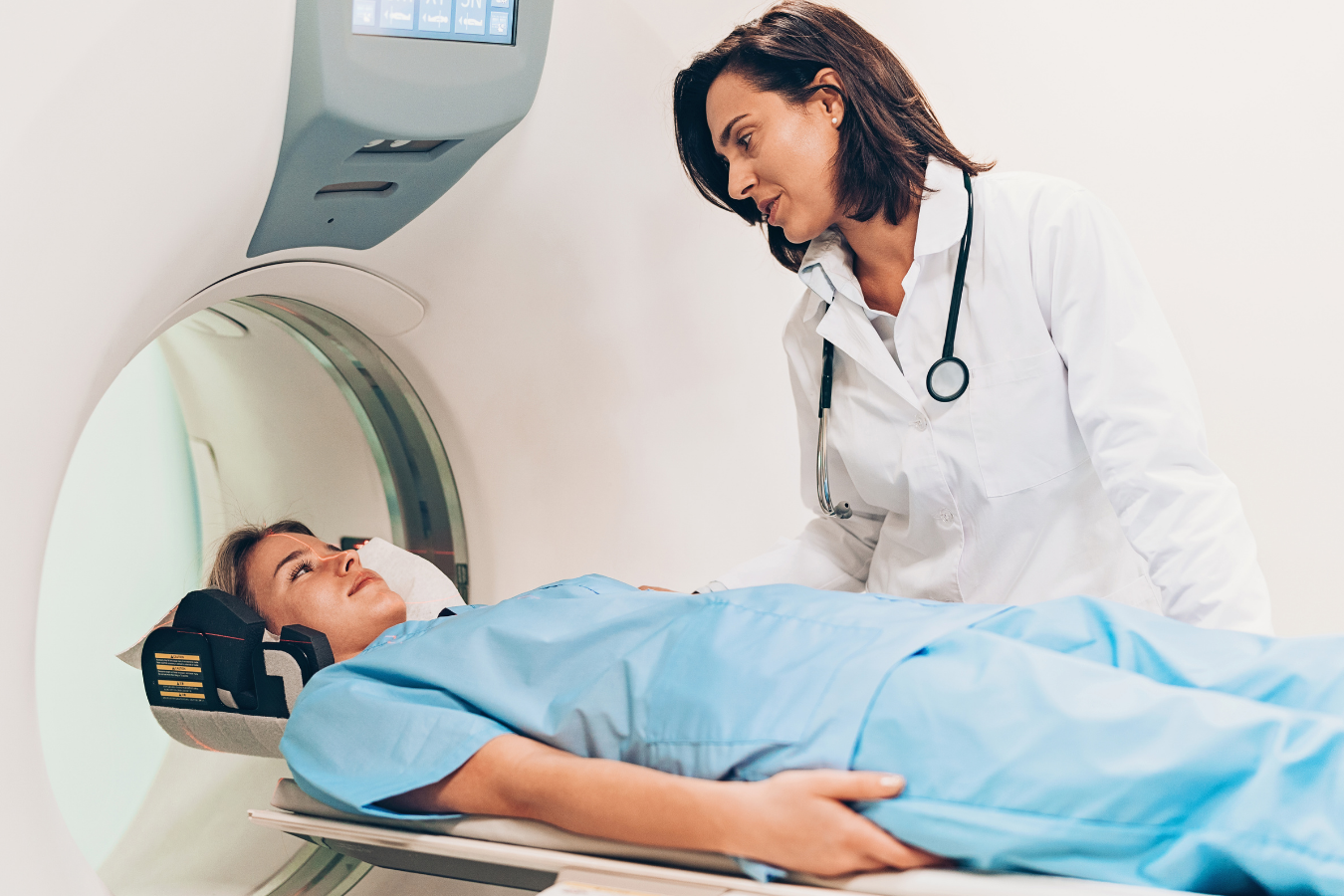
Female patient going into an MRI machine.
The MRI machine uses strong magnets, radio waves, and a computer to create detailed images of the inside of your body.
Its magnets have a pull up to 60,000 times stronger than the earth’s magnetic field!
The powerful magnets pulls radio waves into your body and the waves bounce back, like an echo. The “echo” is sent to the computer as crisp, cross-sectional images (think thin slices of bread). Any jerk, shift, stir, even deep breathing can jeopardize the image quality, making the pictures blurry. So it’s very important to stay as still as possible to get clear MRI images.
Are MRIs Safe?
MRIs are relatively safe. Unlike CT scans and ultrasounds, MRIs don’t contain radiation.
MRIs are also safe if you and the hospital follow safety precautions. As mentioned above, MRIs have such a strong magnetic field that they can turn any metal object in the same room into a dangerous projectile.
In a 2001 tragic accident, a 6-year-old boy was killed when the MRI machine pulled an oxygen tank from across the room into the tube where the boy was lying, crushing his skull.
If you have metals or devices inside your body, you might not be able to have a scan. That's because the objects may be attracted to the magnet, stop working, or cause the images to be blurry.
Metal implants or medical devices include:
A pacemaker
Artificial heart valves
Metal clips
Dental implants or braces
An intrauterine device
Metal pins, screws, plates, stents, or surgical staples
Metal fragments, including a bullet or shrapnel
If you have a tattoo, especially the older ones which contain metal, an MRI may heat up your tattoo and burn you.

Some tattoos have metallic ink that can heat up in the MRI machine and burn you.
If you’re a welder, machinist, or you work regularly with metals, you may have metal fragments in your eyes. The MRI scanner can dislodge the metal fragments, causing you to go blind.
Electronic devices like cell phones, or metal objects like jewelry, hairpins, and bras with an underwire, are not allowed in the MRI room. Some makeup contains metals so it’s a good idea to not wear any makeup on the day of your MRI procedures.
MRIs are not recommended for pregnant women. Doctors don’t yet know the impact of the magnetic field and radio waves on the fetus. As for nursing women, research seems to show that there’s a minimal chance that the dye gets into a baby’s bloodstream through breastmilk. However, medical staff may hold off on an MRI test until a woman has stopped breastfeeding.
The 5 Things You Can Expect During Your Scan
#1. It Starts with a Careful Assessment
Before my scan, I filled out a survey about metals that may be inside my body. I also answered questions about whether I have tattoos or piercings, how many surgeries I’ve had and when I had them, and whether or not I may be pregnant or nursing.
After completing the survey, I changed into a paper-thin blue hospital gown, keeping on my underwear, shoes, and socks.
My MRI technician, Diane, went over my medical history to make sure that I didn’t have any metals in or on my body. She started an intravenous (IV) in my arm, let me know that my scan would be 20 minutes, and took me into the exam room.
I laid face-down on the padded table and put my face in what looked like a massage table hole so that I could breathe. Once I put my arms above my head, and Diane placed a panic button into my hand in case I needed help. She told me not to move and left the room to control the scan from a computer.
#2. It’s Really Cold
Imagine walking into a refrigerator in your nightgown. Okay, it’s not quite that cold, but it’s not like being on a white-sand Jamaican beach either. There’s a good reason for the coldness.
The machine needs to have a very strong and stable magnetic field. To create the right magnet strength, large electrical currents must run through the wires. But wires create some resistance to the flow of the current. To stop that from happening, MRI designers made the wires very cold by putting them in liquid Helium, which is -270 degrees celsius. When a wire is cold enough to lose all resistance, it’s called a superconductor.
So I was shivering in my socks because the magnets were being kept cold to superconduct. Diane did her best to keep me warm by laying a blanket on my legs before the scan.
#3. You May Get a Dye Injected Into You
Some MRI tests, including those to screen for breast cancer, require that you have a contrast dye, like gadolinium, injected into your vein. My MRI technician injected the contrast material into an IV line in my arm to get a clearer picture of my breast tissue.Not all scans, however, require that you get the dye.
Halfway through my scan, Diane announced through an intercom that she would start the injection. Within 3 seconds, I felt a cold burn in my arm at the IV site. The pain lasted about 10 seconds. Not that long, but long enough for me to think, “when is this going to stop?” The dye can leave a metal taste in your mouth. It didn’t for me.
If your MRI test requires that you get a dye, there's a chance that you'll experience side effects. Side effects include:
Headache
Nausea
Dizziness
Coldness at the injection
Severe side effects include itchy skin, trouble breathing, blood clots, and a disease called nephrogenic systemic fibrosis.
If you have kidney problems or severe kidney disease, the dye may cause serious problems. If that's the case, you may get a dye not made with gadolinium.

Infographic of the common and rare side effects of the gadolinium contrast dye.
#4. It’s a Tiny Tube
The MRI tube, called a bore, is approximately 24 inches in diameter—a very tight space. You can understand why many people feel claustrophobic when inside. Because I was face down, I had the luxury of not seeing how close I was to the sides of the tube. But I closed my eyes anyway and thought about going on a month-long RV vacation with my kids.
Tf you think that you may have a panic attack, ask to have anti-anxiety medication before your scan.
#5. MRIs Are Loud
MRI machine sounds range from a jackhammer to a blaring ‘80s alarm clock to a KitchenAid standing mixer on its highest setting. The electromagnetic fields switching on and off cause the wires to expand, producing earsplitting noises. Some healthcare providers may give you a pair of headphones so that you can listen to music during your scan.
Diane gave me foam earplugs to cut some of the noise. But my ears only got a break for about 10 seconds in-between scans.
Now I wait for the results.

MRI machines are extremely loud.
Resources
ABC News (6 January 2006). Boy, 6, Killed in Freak MRI Accident. https://abcnews.go.com/US/story?id=92745&page=1
Beth Isreal Deaconess Medical Center (2014). Breastfeeding and contrast agents (such as IV dye or swallowed contrast). https://www.bidmc.org/-/media/files/beth-israel-org/centers-and-departments/neonatology/breastfeedingandcontrastagents.pdf
HowStuffWorks.com (9 August, 2001). How strong are the magnets in an MRI machine? https://science.howstuffworks.com/question698.htm
Mayo Clinic Staff (4 September, 2021). MRI. Mayo Clinic. https://www.mayoclinic.org/tests-procedures/mri/about/pac-20384768
Raise Up WA. (n.d.). How strong is the magnetic field in MRI? https://www.raiseupwa.com/writing-tips/how-strong-is-the-magnetic-field-in-mri/
Stachowiak, J. (22 November, 2021). Contrast dyes for MRI in multiple sclerosis. Verywell Health. https://www.verywellhealth.com/contrast-dyes-for-mri-in-ms-3972534
WebMD. (30 September, 2021). MRI: What you need to know. https://www.webmd.com/a-to-z-guides/what-is-an-mri
Yale Medicine (Feb 28 2007). How to stay safe when getting an MRI. https://www.yalemedicine.org/news/mri-safety